
Sapphire FUE or DHI: Which method is suitable for which diagnosis?
Anyone considering a hair transplant will very quickly come across two terms: Sapphire FUE and DHI. Both methods are frequently advertised, both can produce good results, and both have their place depending on the initial situation. However, it is often difficult for patients to understand which method is truly suitable for their individual circumstances.
The most important answer is: A hair transplant should not be decided based on the name of a particular method, but rather on the individual assessment. Crucial factors include the extent of hair loss, the quality of the donor area, the desired hairline, the amount of remaining hair, hair density, age, and the long-term progression of hair loss.
In this article, we explain in an understandable way how Sapphire-FUE and DHI differ, when each method can be useful, and why a realistic analysis is important before any decision.
What does FUE mean in the context of hair transplantation?
FUE stands for Follicular Unit Extraction. In this procedure, individual hair follicle units are taken from the donor area and then implanted into the desired target areas. The donor area is usually located at the back or sides of the head because the hair there is generally more resistant to hormonally induced hair loss.
The FUE technique is now a widely used foundation for modern hair transplants. It allows for the gentle extraction of individual grafts and flexible planning of the recipient areas. However, it's important to note that the technique alone does not determine the result, but rather the quality of the planning, the distribution of the grafts, and the natural shaping of the hairline.
What is Sapphire FUE?
At the Sapphire FUE The hair follicles are extracted individually, just as in classic FUE. The key difference lies in the preparation of the target channels. These are opened with fine sapphire blades. The extracted grafts are later inserted into these channels.
Creating the hair channels is an important step because it determines the direction, angle, and subsequent distribution of the hair. Precise channel planning can help achieve a natural overall look. This planning plays a particularly important role in hairlines, larger areas, or textured areas of increased density.
When is sapphire FUE a viable option?
Sapphire FUE can be a suitable option, among other things, when larger bald or thinning areas need to be treated. This method can also be appropriate when planning a new hairline or achieving an even distribution over a larger area.
However, the method is not automatically suitable for everyone. Crucial factors include whether enough donor hair is available, the size of the target area, and what density can realistically be achieved.
What is DHI?
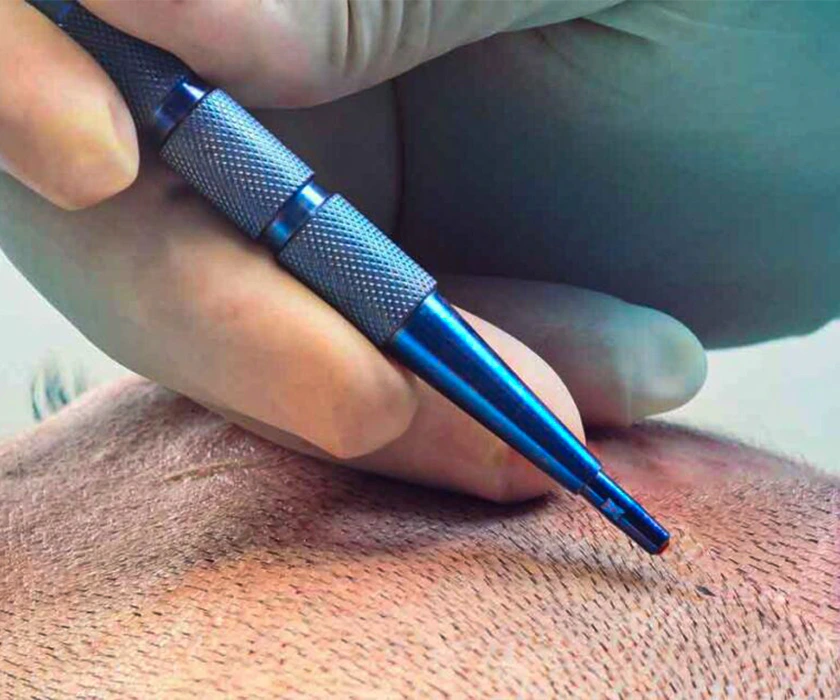
DHI stands for Direct Hair Implantation. In DHI, hair follicles are also extracted individually. The main difference lies in the implantation method. The grafts are inserted directly into the target area using a special implantation instrument.
DHI is often associated with controlled placement, targeted densification, and precise work in smaller areas. Particularly when existing hair in the target area needs to be taken into account, DHI can be an option depending on the findings.
When can DHI be useful?
DHI can be a viable option for smaller target areas, specific hair density issues, or sensitive areas. Direct implantation can also be beneficial depending on the initial situation, particularly when existing hair in the recipient area needs to be preserved and taken into account.
At the same time, it's also true here that DHI is not automatically better than other methods. For larger areas or specific findings, a different approach may be more appropriate. The method must be suitable for the situation.
Sapphire FUE or DHI: What is the most important difference?
The main difference lies primarily in how the recipient areas are prepared and the grafts are inserted. With sapphire FUE, channels are first opened with sapphire blades, and then the grafts are inserted. With DHI, the implantation is performed more directly using a special instrument.
| criterion | Sapphire FUE | DHI |
|---|---|---|
| Basic principle | FUE extraction with channel opening using sapphire blades | FUE extraction with direct implantation |
| planning | Easily structured for hairline and larger areas | Targeted placement in selected areas is possible. |
| Suitable for | Hairline, area, greater density | Smaller areas, densification, existing residual hair |
| Decisive | Donor area, target area, canal direction, graft distribution | Donor area, target area, existing hair, density planning |
What factors determine the appropriate method?
The choice between sapphire FUE and DHI should always be made on an individual basis. The following factors play an important role.
1. Extent of hair loss
Small receding hairlines require a different approach than a large bald patch on the crown. The larger the area, the more important a realistic graft distribution becomes. Maximum density isn't always the most sensible goal. Often, a natural, long-term suitable plan is more important.
2. Quality of the donor area
The donor area is the most important resource for a hair transplant. If only a limited amount of hair is available there, particularly careful planning is required. A thorough assessment determines how many grafts can be extracted without visually diminishing the donor area.
3. Existing hair in the target area
If a significant amount of the patient's own hair is still present in the target area, the procedure must be performed with great precision. In such situations, targeted transplantation may be advisable, depending on the specific findings. Simultaneously, it must be assessed whether the existing hair is stable or whether the hair loss could progress.
4. Hairline and face shape
A natural hairline isn't created by simply drawing the line as low as possible. It must suit the age, face shape, forehead, hair density, and long-term development. An unsuitable hairline can look artificial, even if the technique is flawless.
5. Expectations and long-term planning
Many patients desire a very high density. However, from a medical perspective, a plan that also works in the long term is advisable. If further hair loss occurs later, the current result should still appear harmonious.
Is sapphire FUE better than DHI?
This question is frequently asked, but there's no single answer. Sapphire FUE isn't automatically better than DHI, and DHI isn't automatically more modern or of higher quality. Both methods can be effective when used appropriately.
What matters is not which method sounds more familiar, but which method is best suited to the individual case. A successful hair transplant therefore doesn't begin with a specific method, but with an analysis.
Why an analysis before hair transplantation is so important
A thorough assessment considers several factors simultaneously: photos, hair loss pattern, donor area, age, expectations, medical information, and desired outcome. Only then can a realistic method be determined.
Good consultation should also explain limitations. Not every desired hair density is practical, not every hairline is suitable in the long run, and not every condition is appropriate for every technique. This honesty is crucial to avoid later disappointment.
Typical mistakes in method selection
A common mistake is choosing a method solely based on before-and-after pictures or advertising claims. What looks good on one person might not automatically be suitable for your own situation.
Another mistake is wanting as many grafts as possible without regard for the donor area. A hair transplant should always be planned so that the result looks natural and the donor area is protected.
Conclusion: The method must be suitable for the individual.
Sapphire FUE and DHI are two modern hair transplant methods. Both can be suitable depending on the individual case. However, the decision should never be made categorically. A realistic analysis, natural hairline planning, and a method that suits the individual's starting point are crucial.
Anyone wanting to know which method is suitable for their individual situation should first seek a personal assessment. This will allow for a better evaluation of which treatment is medically appropriate and what result can realistically be expected.
Would you like to know which method is suitable for your diagnosis?
You can discreetly submit your information via the free hair analysis. Estevita will review your situation and provide you with an initial, realistic assessment.
Frequently asked questions about Sapphire FUE and DHI
Which method is gentler?
This depends not only on the method, but also on planning, extraction, implantation, and aftercare. Both methods can be performed gently if used appropriately.
Is DHI always better for existing hair?
DHI can be an option in certain situations where hair is already present. Whether it is truly beneficial depends on the target area, hair density, and medical findings.
Can sapphire FUE and DHI be combined?
Depending on the planning, a combination of different approaches may be possible. Whether this is advisable should be assessed on a case-by-case basis.
How many grafts do I need?
The required number depends on the size of the target area, the desired density, the donor area, and long-term planning. Providing a general figure without analysis is unreliable.
When will we see the final result?
The development process is gradual. Initial changes become apparent after a few months, but the final result is usually only assessed after several months to about a year.